Jump to content
Gemini now has added data protection. Chat with Gemini to save time, personalize learning and inspire creativity.
Gemini now has added data protection. Chat now.

Education technology that’s easy to use, and

Scrolling Earth illustration grows, showing education and sustainability themes.

Creating a better world for students to inherit

66%

global average carbon-free energy* across our data centers and offices.

100%

annual match of Google’s global electricity use with renewable energy purchases since 2017.

120%

percentage of our annual freshwater consumption that we aim to replenish, on average, across our offices and data centers by 2030.

Google for Education is here to help you meet your sustainability goals

Advance your school's sustainability goals with Google for Education

Built with sustainability in mind, Google for Education tools help enhance instruction and prepare your school for tomorrow.

Chromebooks are built to last

Chromebooks have many parts that can be repaired. Schools can send their devices out to be repaired, or they can even set up their own in-school repair program.

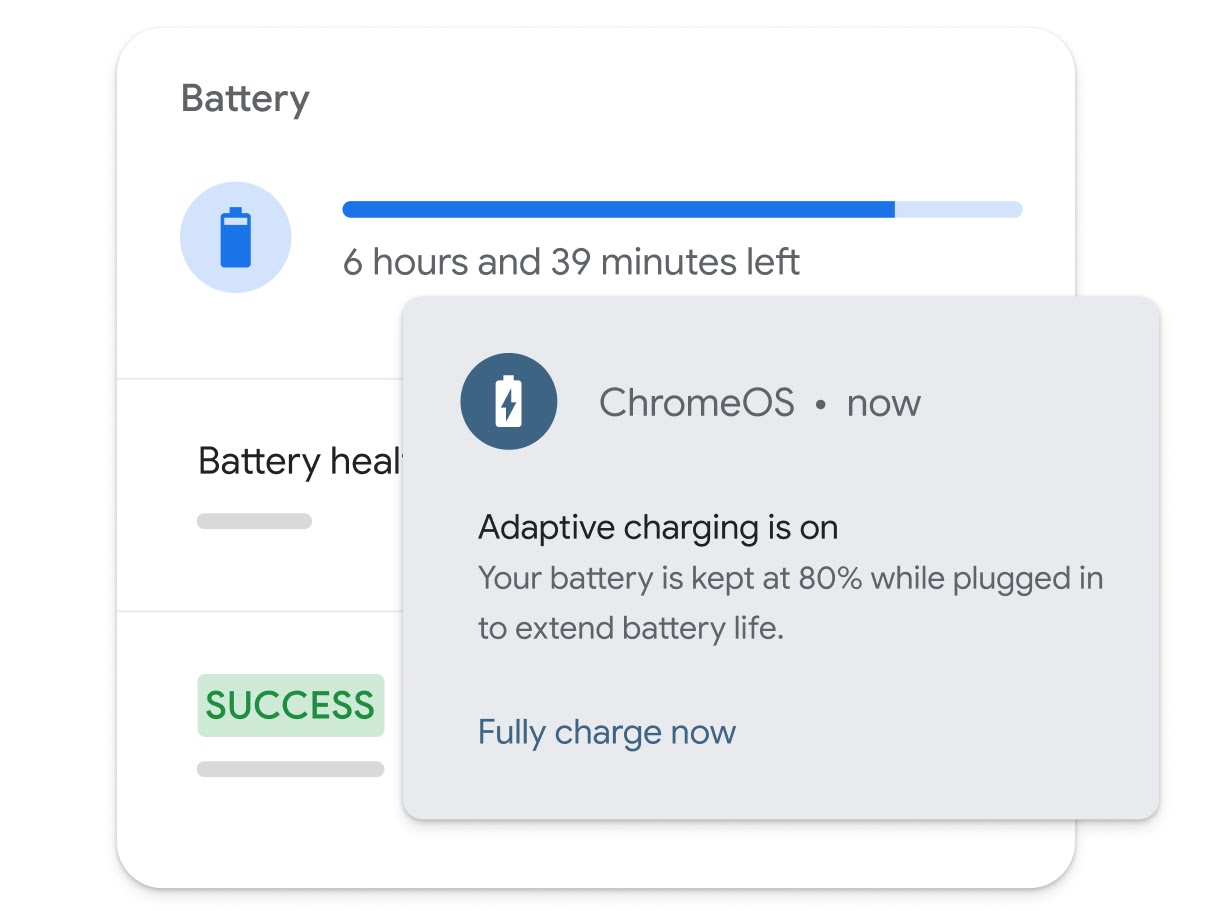
Innovative features like adaptive charging helps preserve battery health, while battery saver will reduce or turn off energy-intensive processes.

Chromebooks are designed with recycled materials, and can be used by numerous users over a long period of time. And best of all, they get 10 years of automatic updates.

All devices reach a time when they stop being useful, especially as hardware evolves. Schools can either sell or recycle Chromebooks via their reseller, who will often collect them onsite. (Before you turn them over to a remarketer or recycler, make sure all devices are removed from management first.)

You can also search for drop-off recycling locations near you with our global recycling drop-off points feature in Google Maps.

A diagram of a disassembled Chromebook shows all of the different parts of the device that can be repaired or replaced.
A battery notification shows that ChromeOS is using adaptive charging to preserve battery life.
An illustration of a Chromebook with a flower and a recycle logo drawn on it.
A screenshot from Google Maps shows the location of a Green Recycling Center for Chromebook recycling.

Support your sustainability efforts with Google Workspace

Get a better understanding of the emissions associated with your school’s use of Gmail, Meet, Docs, and other Workspace products.

Leverage AI that is remarkably efficient. A median Gemini Apps text prompt uses only 0.24 Wh of energy (less than watching 9 seconds of TV) and just 0.26 mL of water (5 drops).

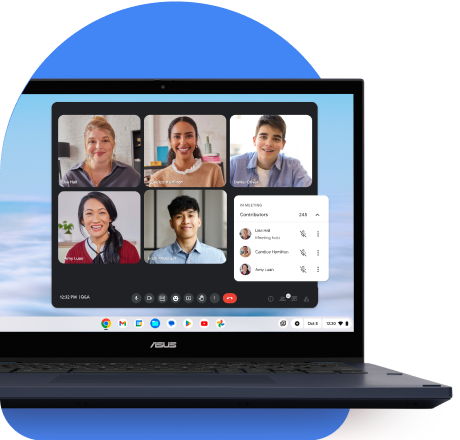
Google Meet provides productive virtual learning with moderator control and engagement features that save time while reducing the need to travel, including for parent-teacher conferences, professional development, or to connect with guest speakers virtually.

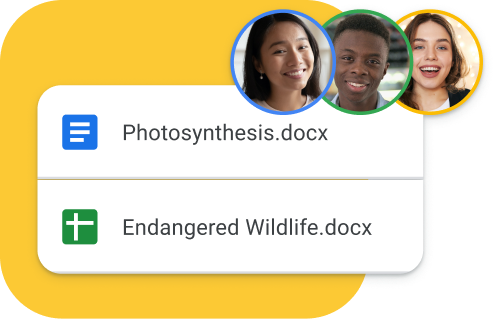
Google’s suite of products enables schools to collaborate more efficiently while saving time and reducing the need for paper usage.

An abstract UI shows the Google Classroom interface being used by a classroom.
Gemini UI appears, displaying “Hello, Lisa. How can I help you today?” A prompt is entered. Gemini displays a response.
A screenshot of Google Meet shows two people, Maria and Zach, on a call with each other, as well as all of the features they can access during their call.
An abstract screenshot of Google Docs shows a teacher commenting “This is looking great!” on a block of text.

Protecting our shared learning environment

Google for Education is built on a cohesive system of processes, programs, and tools designed to reduce environmental impact.

Support a sustainable future with every Chromebook

Chromebooks are durable and built to withstand wear and tear before needing repairs. A repair program can ensure you get the most out of your devices for years to come, which means less waste for an earth-friendly approach to education.

Minimize waste

3D-animated child using a tablet with a stylus. A convertible tablet with the Google Chrome logo nearby.
Keep your devices in service longer to keep them out of the e-waste bin.

Perform repairs in-school

3D-animated high-school student sitting at a desk using a Chromebook. A pair of headphones is on the desk.
Read our guide on creating your own in-house repair program at your school.

Find repair guides

3D-animated still image of a eacher standing and pointing at a  whiteboard
Google works with manufacturers to establish repairability criteria so that many components can be fixed locally.

Learn more about Chromebook repairs

Chromebooks have individual repair manuals. Whether repairing in-school or shipping out, find your device guides here.

Error loading content :(

Please try again later

To learn more about Acer repairability, contact Acer.

Review the terms and conditions of your product's warranty at Lenovo.com.
You can also purchase genuine Lenovo replacement parts directly from Lenovo here.

To learn more about CTL repairability, contact CTL

No results matching your selection :(
Clear filters to show all results

Manufacturers offer safety training to help ensure successful repairs. Please check your warranty before performing repairs.

Frequently asked questions

*Carbon-free energy is any type of electricity generation that doesn’t directly emit carbon dioxide, including (but not limited to) solar, wind, geothermal, hydropower, and nuclear. Sustainable biomass and carbon capture and storage (CCS) are special cases considered on a case-by-case basis, but are often also considered carbon-free energy sources.

Sign up here for updates, insights, resources, and more.